
Wichita Falls, TX · Answered 24/7
Sewer Line Repair in Wichita Falls, TX
Repeat backups are rarely a clog problem. They are a pipe problem. As experienced sewer line contractors, we put a camera down the lateral for a full sewage line inspection, use jetting equipment to clear the buildup, locate the defect, and repair the section that is failing.
- Root intrusion, offsets, bellies and collapsed sewer line repair
- Sewer line jetting, sewer line cleaning and depth marking before digging
- Residential sewer line repair where a spot repair is genuinely enough

Direct answer
How do you know whether a sewer line needs repair or just cleaning?
A sewage line inspection with a camera settles it. If the line is structurally sound and simply loaded with grease, scale or debris, sewer line cleaning restores it. If the camera shows root intrusion through joints, an offset or separated joint, a belly holding standing water, cracking, or a collapsed section, cleaning is only a temporary measure and the pipe needs sewer repair or replacement. The camera also gives the depth and the distance from the cleanout, which is what makes a targeted sewer repair service possible instead of a trench across the whole yard.
Third backup this year?
Call (940) 310-1165 and stop paying to clear the same line. We will camera the lateral, locate the defect to the foot, and give you the repair options with the reasoning for each. You see the footage yourself.
Why laterals fail
The pipe between your house and the main is doing a hard job
Your sewer lateral runs underground at a shallow fall, carries everything the house discharges, and sits in soil that moves with the seasons. Older laterals in this area were built from cast iron, vitrified clay tile or early plastics, and all of them have failure modes that show up decades later.
Roots are the classic one. Tree roots follow the moisture and vapour escaping from a joint, then thicken inside the pipe until they form a mat that catches paper and solids. Clay tile joints are especially vulnerable because they were never sealed the way a modern gasketed joint is.
Soil movement causes the rest. Expansive clay lifting and dropping through wet and dry cycles pushes joints out of alignment, creates offsets that catch debris, and forms bellies where waste water stands instead of flowing. Cast iron adds internal corrosion and flaking to the list, which narrows the pipe from the inside.
What repair looks like
Match the sewer line repair service to the defect, not to the biggest available job
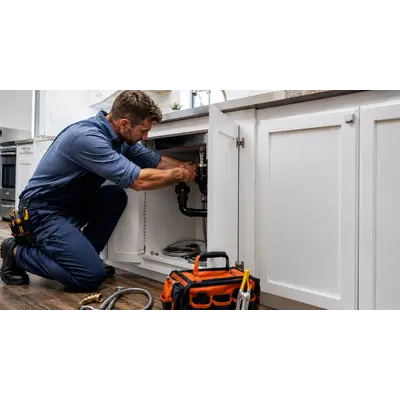
A single root-invaded joint or a cracked section is often a spot repair. We locate the defect, expose only that section, cut it out and replace it with new pipe and proper couplings, then re-camera to confirm the line runs clean and true.
A collapsed sewer line, a line with multiple offsets, a long belly, widespread root intrusion or an advanced cast iron failure needs a full replacement of the run. Trying to patch a lateral that is failing along its whole length is how homeowners end up paying three times.
Every repair pays attention to the things that determine whether it lasts: correct fall, properly bedded and compacted trench, the right transition couplings between dissimilar materials, and a cleanout in an accessible place so the line can be serviced from now on.
How the job runs
Our sewer line repair process
Sewer work is disruptive if it is done blind. This sequence keeps the excavation as small as the defect allows.
- 01
Clear enough to see
If the line is blocked solid, it is cabled first so the camera has a path. You cannot diagnose a pipe you cannot see.
- 02
Camera the full run
The camera travels the lateral from the cleanout toward the main, recording condition, joints, roots, standing water and any break.
- 03
Locate and mark
A sonde in the camera head is tracked from the surface, so the defect gets marked on the ground with its depth before anyone digs.
- 04
Scope the repair with you
You see the footage and get the options: spot repair, section replacement or full lateral replacement, with the reasoning and the trade-offs for each.
- 05
Excavate and repair
The trench is opened at the marked point only, the failed section is cut out, new pipe is installed with correct fall, bedding and couplings.
- 06
Re-camera and backfill
The repaired line is filmed again to confirm flow and alignment, then the trench is backfilled and compacted and the surface tidied.
Warning signs
Signs your sewer line is failing
- Multiple fixtures backing up at the same time, especially the lowest ones
- Repeated main line stoppages after previous clearing
- Sewage odour outdoors near the lateral route or at the cleanout
- Patches of grass that are unusually lush or soggy along one line across the yard
- Gurgling toilets whenever the washing machine drains
- Slow drainage across the whole house rather than at one fixture
- Sinkholes, soft ground or a dip in the lawn following the pipe run
Before we arrive
What to do while you wait on the inspection
- Stop using water in the house. Every flush and every wash cycle adds to a line that cannot carry it.
- Keep everyone away from any area where sewage has surfaced, including pets, and do not hose it into a storm drain.
- Locate your cleanout if you know it. It is usually a capped pipe near the foundation or at the property boundary, and clear access speeds up the whole job.
- Move vehicles off the driveway and clear the likely pipe route so the locate can be done accurately.
- If sewage has entered the house, photograph it before anything is cleaned up, in case an insurance claim follows.
Why us
Why homeowners here keep our number
You see the footage
No homeowner should be asked to approve excavation on someone's word. The camera run is shown to you, defect by defect.
Located, not guessed
The sonde locate marks the defect and its depth on the surface, which is the difference between a small trench and a ruined lawn.
Right-sized repairs
If one section is bad, we replace one section. We will not sell a full lateral replacement to fix a single failed joint.
Correct materials and fall
Proper couplings between dissimilar pipe, correct bedding, and fall set to code, because a line laid flat will simply fail again.
Cleanout access left behind
Where a property has no serviceable cleanout, we add one, so future maintenance never requires pulling a toilet.
Sewer repair in Wichita Falls
What is actually under the yards in this city
Wichita Falls has a wide spread of housing ages, and the sewer lateral usually matches the era of the house. Homes from the pre-war and mid-century periods near downtown, Floral Heights and the older streets around Midwestern State frequently still have cast iron under the slab transitioning to clay tile in the yard. Both materials are past their design life.
Mature trees are the other factor in those same neighbourhoods. Established root systems find clay tile joints reliably, and the pattern of repeat backups every autumn and spring is almost always root related rather than a household habit problem.
Outside the city limits the picture changes. Many properties in Archer City, Pleasant Valley, parts of Iowa Park and rural Clay and Wichita county addresses are on septic rather than city sewer, so a backup means inspecting the tank, baffles and drain field as well as the house line. We diagnose the whole system rather than assuming a blockage.
Pricing
What does sewer line repair cost in Wichita Falls?
To give you a realistic anchor: a single-joint spot repair in a shallow yard trench typically runs $400–$900. A partial lateral replacement (10–20 ft section) in a standard yard trench usually falls in the $1,500–$3,500 range. A full lateral from house to city main, or any repair under a concrete driveway or slab, runs higher — these jobs are quoted after the camera and locate, not before.
Sewer repair costs depend on the depth of the line, the length of the damaged section, the repair method required, and whether the failure is under a slab, in the yard, or under a driveway. A single joint replacement in a shallow yard trench is a very different job from a full lateral replacement at six feet of depth under a concrete drive.
We camera the line first, locate the defect with a sonde, and give you a written price that covers excavation, materials, backfill and cleanup before any digging starts. You see the footage, you see the locate marks, and you approve the number. No surprises once the trench is open.
Service area
Plumbers for Wichita Falls and the towns around it
We run sewer line repair calls across Wichita Falls and every town in our 940 service area. Pick your town for local detail, or call and we will confirm coverage in seconds.
FAQ
Questions we get asked on the phone
How long does a sewer camera inspection take?
Can roots be removed without replacing the pipe?
What is a belly in a sewer line?
Do I need a permit for sewer line work?
Is trenchless repair an option here?
Who is responsible for the pipe in the street?
Related services
Other work that often comes with this job
Drain Cleaning
Cabling, hydro jetting and a camera check so the clog does not come straight back.
Read moreEmergency Plumbing
Live answer around the clock for failures that cannot wait until morning.
Read morePipe Repair & Repiping
Section repairs and planned whole-home repipes in PEX or copper.
Read moreOne call ends it
Sewage backing into the house is a health problem, not just a plumbing one
Category 3 water carries bacteria into everything porous it touches, and a failed lateral will keep sending it back. Call (940) 310-1165 and we will inspect, locate and repair the line so the backups stop for good.
Call (940) 310-1165