
Wichita Falls, TX · Answered 24/7
Burst and Frozen Pipe Repair in Wichita Falls, TX — 24 Hours
Plumbing frozen pipes are burst lines waiting for the thaw. We locate the freeze, thaw it safely, and repair what the ice has already split. 24 hour emergency plumbing for burst and frozen pipe repair.
- Safe thawing methods, no open flame in your walls
- Burst sections cut back to sound pipe and replaced
- Freeze-risk survey so it does not happen again
Direct answer
What should you do the moment a pipe freezes?
Close the main shut-off first, because most of the damage from a frozen pipe happens when it thaws and releases pressurised water through the split. Open the affected faucet so melting ice has somewhere to go and pressure cannot build behind the blockage. Apply gentle heat to the frozen section with a hair dryer or heat lamp, working from the fixture back toward the freeze, and never use a torch or open flame. If pressure does not return or water appears anywhere, the pipe has already split and needs a plumber.
Faucet running dry on a freezing morning?
Call (940) 310-1165 before you start thawing anything. We will tell you exactly where to shut off and which methods are safe, and have a licensed plumber to you while the line is still frozen rather than after it lets go.
What ice actually does
Water expands as it freezes, and pipe has nowhere to go
Freezing water expands by roughly nine percent. Inside a closed pipe that expansion has to go somewhere, and the pressure it creates is what splits copper along its length or blows out a fitting. The failure is often not at the ice itself but downstream, where pressure builds between the ice plug and a closed faucet.
The split usually stays sealed while everything is frozen. That is why so many homeowners believe they escaped, right up until the afternoon sun warms the attic and the line releases into the ceiling. In a hard freeze event, the emergency calls come in waves on the thaw, not during the cold snap.
The vulnerable runs are predictable: attic lines above insulation, pipes in exterior walls, garage and crawl space runs, hose bibs left connected to a garden hose, and anything in an unheated laundry or utility room. Those are the places North Texas freezes reach because they were plumbed for heat, not for cold.
Thawing and repair
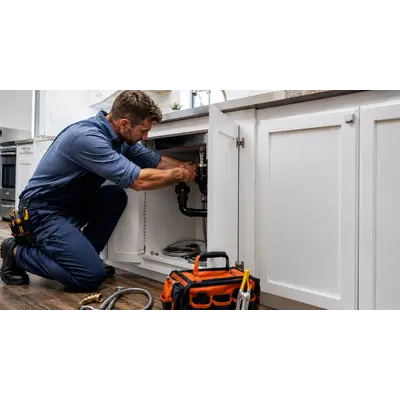
Control the thaw, then repair what the ice broke
The first step is always isolation. With the main closed and the affected fixture opened, a thaw cannot turn into a flood, and any split that already exists will show itself as soon as pressure is reapplied under supervision.
Thawing is done with controlled heat: heat lamps, hair dryers, heated blankets or pipe-safe thermal methods applied progressively from the open fixture back toward the plug, so meltwater can escape. Open flame is never used, and neither is a heat source left unattended against framing or insulation.
Repair follows. A split section is cut back to sound material on both sides and replaced with new pipe and proper fittings, then the system is brought back to pressure and held while every joint and the surrounding structure is inspected for the second failure people forget to look for.
How the job runs
Our burst and frozen pipe repair process
Freeze calls run in a strict order because the wrong step at the wrong moment turns a frozen pipe into an interior flood.
- 01
Isolate before anything warms up
Main shut-off closed, affected fixtures opened, and if a burst is already leaking, power isolated from any circuit near water.
- 02
Find the frozen section
We follow the run and use surface temperature readings and thermal imaging to identify where the plug sits, rather than heating the whole attic and hoping.
- 03
Thaw under control
Progressive heat from the fixture side back toward the plug, at a rate the pipe can take, with the escape path open the whole time.
- 04
Repressurise and watch
Water is restored under direct observation so any split reveals itself while a plumber is standing at the shut-off, not overnight.
- 05
Cut out and replace failures
Split sections are removed back to sound pipe and replaced with correct material and fittings, then tested at pressure.
- 06
Survey the rest of the house
Every other exposed run gets checked, because the conditions that froze one line applied to all of them. We identify what needs insulating, sealing or rerouting.
Warning signs
Signs of a frozen or burst pipe
- One faucet delivers nothing while others still run normally
- Visible frost or condensation on an exposed pipe run
- Bulging, splitting or a bright line along a copper pipe
- Strange banging or gurgling from the walls during a cold snap
- Water stains appearing on a ceiling or wall during a thaw
- A hose bib that will not deliver water after freezing weather
- A meter dial that is turning while every fixture is closed after a freeze
Before we arrive
Do this immediately, in this order
- Close the main shut-off. Do this before applying any heat at all, so a hidden split cannot release under pressure.
- Open the faucet served by the frozen line, hot and cold, so meltwater has an escape path and pressure cannot build behind the ice.
- Apply gentle heat with a hair dryer or heat lamp starting at the fixture and working back. Never use a torch, propane heater or open flame near framing or insulation.
- Open cabinet doors under sinks on exterior walls to let room heat reach the pipes, and disconnect any garden hose from an outdoor bib.
- Check the ceiling below any attic run and photograph any staining. If water is coming through, keep it isolated and call immediately.
Why us
Why homeowners here keep our number
We work through freeze events
When a hard freeze hits North Texas, demand spikes and many companies simply stop answering. Our line stays staffed through the whole event.
Safe thawing, correctly done
Improvised thawing with torches and space heaters causes house fires every winter. Controlled heat and a proper escape path is the only method we use.
Repairs cut back to sound pipe
Ice damage extends past the visible split. We remove back to material that is genuinely sound rather than patching at the crack.
Prevention included
After the repair, you get a clear list of the runs that are exposed and what will keep them from freezing next time, from insulation to rerouting.
Documentation for your claim
Photos of the failure and the repair, plus a plain description of the cause, so an adjuster has what they need.
Freeze damage in Wichita Falls
North Texas freezes are short, sharp and hard on plumbing
Houses in Wichita Falls are built for triple-digit summers. Insulation strategy, attic ventilation and pipe routing all reflect a hot climate, which is exactly why a sustained hard freeze finds so many weak points at once. The February 2021 event across Texas made that obvious at a scale nobody in this region had planned for.
The runs that fail here are consistent: supply lines above the insulation line in vented attics, laundry boxes on exterior walls, garage runs to a water heater, and hose bibs on the north and west faces of the house where wind chill hits hardest. Older homes near downtown and the university with limited wall insulation are particularly exposed.
Wind is the multiplier. Sustained north wind across open country pushes cold into attic vents and wall cavities faster than still air at the same temperature, which is why pipes here can freeze at temperatures that would be survivable elsewhere. Insulating the run is only half the job; sealing the air path to it is the other half.
Pricing
What does burst or frozen pipe repair cost in Wichita Falls?
Costs depend on the location of the burst, the material and size of the pipe, how much of the run sustained ice damage, and whether the repair is in an accessible wall cavity or requires opening a ceiling or slab. A single burst joint in an accessible utility room is a very different job from multiple splits across an attic run.
We assess the full extent of the damage, not just the visible break, and give you a written price before any repair work starts. If freeze prevention measures like insulation or rerouting make sense, we quote those separately so you can decide what to address now versus later.
Service area
Plumbers for Wichita Falls and the towns around it
We run burst and frozen pipe repair calls across Wichita Falls and every town in our 940 service area. Pick your town for local detail, or call and we will confirm coverage in seconds.
FAQ
Questions we get asked on the phone
How cold does it need to get before pipes freeze?
Should I leave my faucets dripping in a freeze?
Can a frozen pipe be saved if it has not burst?
Why did my pipe burst after the weather warmed up?
What is the best way to protect pipes before winter?
Does homeowners insurance cover burst pipes?
Related services
Other work that often comes with this job
Emergency Plumbing
Live answer around the clock for failures that cannot wait until morning.
Read morePipe Repair & Repiping
Section repairs and planned whole-home repipes in PEX or copper.
Read moreLeak Detection & Repair
Acoustic and thermal location so the repair is targeted, not exploratory.
Read moreOne call ends it
The damage happens on the thaw, not the freeze
Ice splits the pipe silently, then the split releases everything the moment temperatures rise. Call (940) 310-1165 and we will shut it down, thaw it under control, replace the split section and check the rest of the house for the same exposure.
Call (940) 310-1165